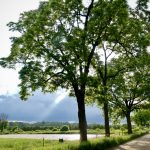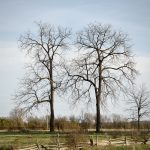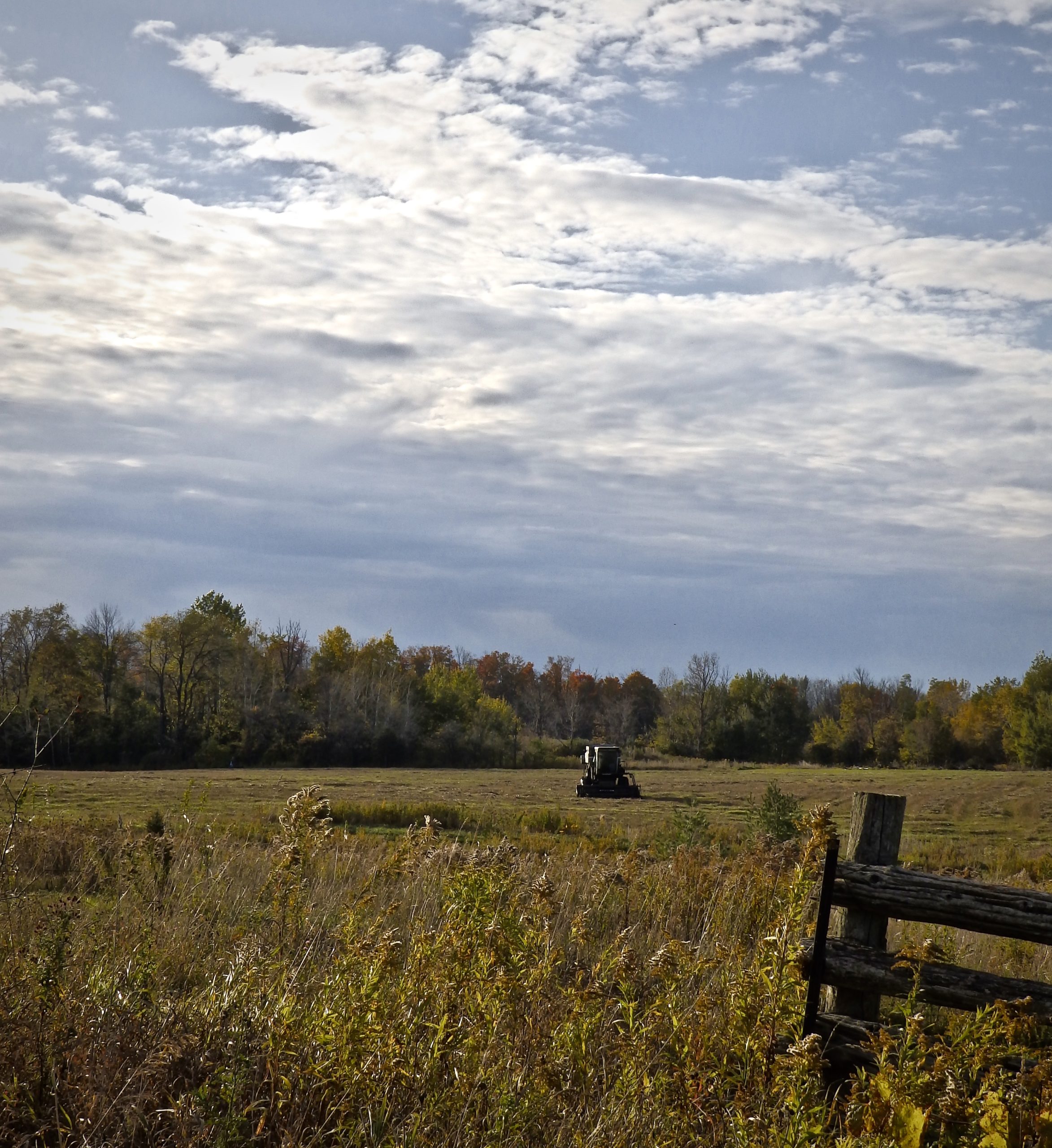
This year, as we celebrate the Season of Creation at Ignatius Jesuit Centre, we do so with a spirit of transition. While Loyola House has long been a place of prayer, rest, and encounter with God, as its retreat ministry winds down, our community is shifting into new ways of gathering and connecting. Change always brings mixed emotions, but it also opens space for renewal.
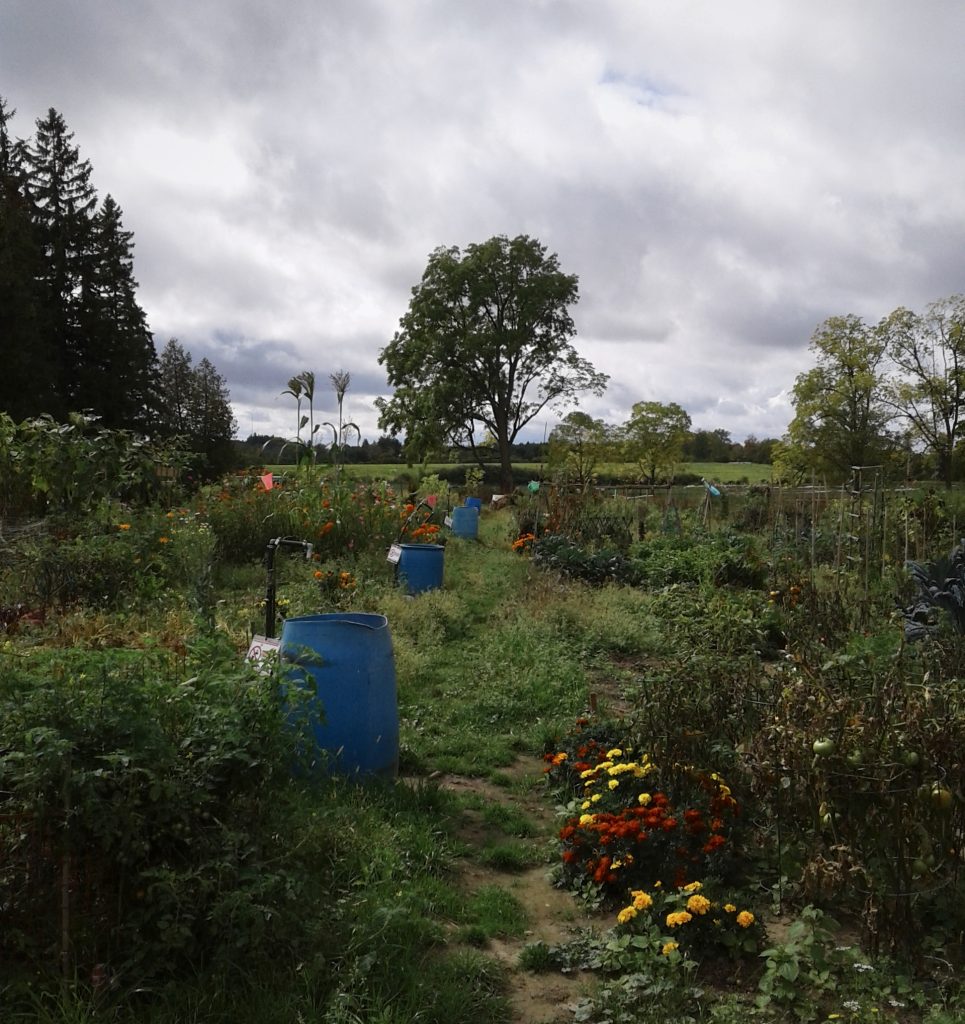
At the same time, the wider Ignatius lands remain a living place of encounter. In her essay “Ministry to Place and Placelessness in a Globalized World,” Sister Mary Frohlich, RSCJ, reminds us that sacredness is not limited to a single building. Our need for connection to place is deeper. It is found in the soil, the trees, and in the communities we form as we care for creation together.
Sister Mary challenges us to see that every place, not just the beautiful or familiar ones, can become holy ground when we approach it with attention and reverence. A forest trail, a city block, even a noisy workplace holds the potential to draw us into God’s presence if we allow ourselves to be fully present there. She also reminds us that being rooted in place carries responsibility — to notice, to learn, and to care. In a world where so many feel unrooted or “placeless,” rediscovering our bond with the land is not only good for the earth, but vital for our spiritual well-being.
by Sister Mary Frohlich, RSCJ
A few years ago I spent the summer in San Diego, which was a new place for me. On my very first morning there, I woke up early, dressed, and walked the neighborhood. It was as if I needed to know where I was — to touch the earth, make acquaintance with the flora and fauna, and begin to find a way for it to be a “home place” for me. The next morning I again got up early and drove to the beach. Missing turns on the freeways and roads, I took the long way to get there; yet something in my soul was happy, because by blundering about I was getting oriented. That process continued throughout the twelve weeks that I lived there, as I made my way around the city and made forays in all directions to nearby trails, beaches, canyons, and parks.
Humans have a basic need for a connection to one or more specific earth-places. This is a need that seems to be rooted at an instinctual, bodily level and on that basis has been built into every culture, every political system, and every religion. Not everyone, of course, has to search for this sense of place in the way I did during my sojourn in San Diego; some already have such connections, forged over a lifetime or longer, perhaps rooted deep in ancestral time. These are the people who, when faced with that perennial conversation starter, “Where are you from?”, know the answer right down to a specific beloved house, the local lineages of wildlife, the most intimate dimples and rises of landscape, the songs and groans of the wind as it plays in their home place.
Fewer and fewer people, however, have the privilege of such a contented marriage to one geographical locale. Whether through economic necessity, exile, or sheer upward mobility, people everywhere are on the move. In postindustrial societies, it is not uncommon for people to pick up and move 10, 20, or even 30 times during a lifetime. Meanwhile, in the so-called Third World, people by the millions are leaving the countryside to flow into city slums, or crossing borders and oceans in desperate search of safety and livelihood. Connection to place can no longer be taken for granted; rather, it can only be consciously claimed and constructed against a building tide of counter-forces. Assisting people in rebuilding connections to “place” may be one of the most crucial elements of ministry in the world of the twenty-first century.
Globalization and Placelessness
The terrible risk inherent in the economic and political processes at work in the world today is that people are being disconnected en masse, not only from their specific places but from any sense of place at all. In his popular presentation of the reality of globalization, The Lexus and the Olive Tree, Thomas Friedman asserted that the present era is one in which every part of the globe is connected to every other part with the ever-increasing speed of the “Lexus.” His claim is that henceforth the forces of free-market capitalism will brutally and inexorably rule every significant decision that is made.
While Friedman acknowledges that the human attachment to “Olive Trees” – that is, one’s ancestral land, local culture, and sense of peoplehood – still has power in people’s lives, he mainly presents it as a reactionary force. In his view those who would give primacy to such concerns are really to be pitied, for they are doomed to be literally run over by the speeding Lexus on its way to modernization and higher standards of living. Friedman’s characterization of the situation cannot be ignored; for, indeed, the high-speed Lexus of present economic change is not likely to be stopped without an horrific crash. Yet it is equally true that failure to balance care for the Lexus with care for the Olive Trees will result in an equally tragic disaster; for such short-sightedness will destroy the health of the earth and, in the same stroke, the spiritual well-being of each human being.
The spirituality of place that is being proposed for this balancing act is not just about sacred places, or wild places, or places of inspirational beauty; rather, it is about rediscovering the primordial and inescapable reality of who we are – creatures brought forth from the clay of the earth, fed by the vital juices of its plants and animals, utterly dependent upon its air, gathered into community around the hearth of its gift of fire. The most beautiful and religiously significant places can be mere commodities if we treat them as such. On the other hand, any place – even a trash-strewn city lot, an upper-floor high-rise apartment, or a noisy factory floor – can be “sacred place” if we participate in it in a way that is holistic, realistic, and fully cognizant of its connections within an encompassing and complex network of ecosystemic relationships.
Built into Our Bodies
In a book entitled The Humanizing Brain, Carol Albright and James Ashbrook discuss how the evolutionary process has built the need for this kind of connected participation in place into the very structure of our nervous systems. They observe that the structure and functioning of the human brain includes a foundational layer that is almost identical to that found in reptiles. These structures continually orient us by a sense-based grounding in our immediate physical location. The human brain has other layers, of course: one shared by all mammals and oriented to social and emotional cues, and a uniquely human layer that includes the capacity for abstract thought and creative choice about how to deal with the impulses arising from the reptilian and mammalian inclinations. That most foundational “reptilian” level is always operative, however, and it helps to explain such perennial human phenomena as the gut-longing for “a place of one’s own,” the pleasure felt in gaining intimate familiarity with a locale, or the anxiety felt at leaving one’s home place.
This is one way of thinking about why the need for connection to place remains, no matter how sophisticated we become. The orientation to be present, at home, capable of total responsive attunement, in a specific and utterly familiar geographical locale is built into us in the same way our bone structures and hormonal rhythms and sense capacities are built into us. While a human being deploys this need in a very different pattern from that of an alligator or an opossum, we deny our kinship with these “second cousins” at our own peril.

Being in Place
In her book The Lure of the Local: Senses of Place in a Multicentered Society, Lucy Lippard speaks eloquently of the deep challenges involved in being an authentic “local” in a society that is built around frequent geographical mobility. She notes that to “know one’s place” requires hard work on both practical and inner, spiritual levels.
. . . These days the notion of the local is attractive to many who have never really experienced it, who may or may not be willing to take the responsibility and study the local knowledge that distinguishes every place from every other place.
Inherent in the local is the concept of place – a portion of land/town/cityscape seen from the inside, the resonance of a specific location that is known and familiar. Most often place applies to our own “local” – entwined with personal memory, known or unknown histories, marks made in the land that provoke and evoke. Place is latitudinal and longitudinal within the map of a person’s life. . . . . It is about connections, what surrounds it, what formed it, what happened there, what will happen there. (7)
Being in place, then, is as simple and as intricate as any serious relationship. It is as simple as just “being here now,” wherever we are, noticing and attending and caring and taking responsibility for the place and for ourselves. Yet it is also as complex as the labyrinths of memory and dream, where we are sometimes lifted up, at other times wounded or deeply challenged by encounter with the shifting patterns of this place’s geology, history, culture, politics, economics, or ecology. Although it is far more than an academic process, care for the place will call us forth to constant new learning through such disciplines as reading, listening to experts, reflecting, field trips, work projects, and other forms of engagement. There are both profoundly contemplative and profoundly activist dimensions to “being in place.” Perhaps no individual can fully develop all of its potentials; yet care for the place may serve as a conjunction point for the varied gifts that each one brings to it.
Cultural Ideologies of Place
Every culture has an inbuilt way of relating to place. One of the sources of the current eclipse of connection to place may be the tendency of Western cultures – the “drivers” of globalization – toward a relatively one-sided commitment to cultural ideologies that emphasize orientation to time (history), while marginalizing those more oriented to space (place). It is not that one or the other of these orientations is right while the other is wrong; rather, each offers different gifts and a sustainable perspective must find a well-ordered balance between them.
A history-oriented perspective often includes an explicit or implicit assumption that an “ideal place” awaits one somewhere in the future. In this view, the place where one is now is not really the place where one belongs. Taken to an extreme, this perspective permits a group not to value its present physical location for its own sake as much as for its potential as a staging platform for movement toward the ideal future. A yet more extreme form of this is the religious view that history will culminate in the arrival of the blessed in a heavenly world that is not of this earth. The risk of this perspective is that at its worst it permits the earth to be exploited in any manner as long as the focus is kept on “getting to heaven.”
In today’s secularized cultures, meanwhile, this dream of a future ideal place is sometimes played out through the purchase of a vacation or retirement home in a setting of seemingly idyllic natural beauty. Sadly, many of those who move into these wilderness paradises have little consciousness of the impact their arrival will have on the ecosystem into which they are inserting themselves. Stories about homeowners eager to kill bears who visit their barbecues or coyotes who challenge their pet dogs are only the tip of the iceberg. A romanticized vision of the “dream place” in the wilderness as basically a human-centered locale of beauty, relaxation, and freedom from the tensions of city life exemplifies the cultural failure to engage a more holistic spirituality of place.
On a broader scale, the tragic and intractable struggle between Israelis and Palestinians illustrates the different gifts of history-centered and earth-centered ideologies, as well as showing how crucial it is that humanity find a path to a more sustainable balance between them. Many Palestinian families have lived for countless generations in the same house and on the same land, harvesting for hundreds of years from the same ancestral olive trees. For them, rootedness in the family’s specific plot of earth is an unquestionable fact and foundation of being. Newly arriving Israelis, on the other hand, may never have seen the land before, yet from their first day many can articulate a bedrock conviction that this is where they are destined to find their God-given place of fruitfulness and rest. The Israeli ideology is based in the biblical notion of the “promised land” which was given by God, has been lost through exile, and will be regained in the course of history according to the faithful promise of God. For the Palestinian, belonging to this particular place is literally a matter of blood and bone and breath; for the Israeli, belonging to the aretz Israel (“land of Israel”) is founded in the working out of the divine promise in history.
If there is ever to be a resolution to this labyrinthine conflict, it would seem that it would require Palestinians to balance rootedness in the soil with a greater realism about history, while Israelis would have to balance the sense of historical destiny with a more compassionate love for the land and its resident peoples. It would be supremely naive to suggest that this could ever be achieved without tremendous moral and physical cost to all parties. Yet the alternative seems to be a continuation of mutual destruction, with the potential of a conflagration involving the whole earth. Cultural ideologies of place are no small matter; understanding how they develop, and how they can be transformed from within, may be literally a matter of life and death for the coming era.

Learning from Tribal Peoples
As the forces of globalization sweep more and more people away from ancestral lands and into a fast-moving struggle for survival, the urgency of rediscovering how to create and care for connection to place increases. One important place to look for clues is to the wisdom of Native Americans and other tribal peoples, many of whom exemplify an earth-oriented way of life that contrasts profoundly with the profit-focused obsession of mainstream Western culture. Of course, it is not helpful to romanticize Native peoples, who are intrinsically no more nor less saintly than others. What is important is that they have preserved certain attitudes and practices that can be a resource for all of us, if we can learn how to receive them respectfully and non-exploitatively.
To listen to a Native American teach about attention to earth-places can be a bit of a shock to the Western mind. The Native American is more likely to speak by silence, indirection, or stories than by discursive explanation. She or he may speak easily of the manifestation of spirits and other mind-boggling phenomena. In the Native world time is not of the essence; one waits, attends, practices the most profound respect until the “Grandparents” – who may be rocks, animals, or mountains as well as the spirits of those who have passed on – are ready to communicate.
One of the ways that some Native American tribes practice this waiting is the vision quest, in which the seeker simply camps in a single spot for three to ten days while fasting from food and water and praying with humility. George Tinker, an Osage Lutheran theologian, warns against non-Native peoples trying to “play Indian,” but affirms that some modified form of this practice might be deeply enlightening for the jaded “placeless” person. He describes the essence of the practice as staying in a single place, practicing utmost respect, until the place begins to “take you seriously.” Then, it will speak to you in its own way.
Even before hearing Tinker make these remarks, I had an experience that conforms to this pattern. I was spending the summer in a rural location and, separated from my usual fast-paced lifestyle, was experiencing a good deal of loneliness and boredom. As a way of grounding myself, I decided to spend at least an hour every day working on the nearby woods trails. Toward the end of the summer, I paused one day in the midst of my labor and looked out toward where the sun shone through a grove of trees. Without warning, I was overtaken by an awareness that the woods recognized me, and was shyly welcoming me into its most intimate life.
It is hard to give an adequate account of this experience because it was something quite different from my usual, rather sentimental enjoyment of the beauty and peace of the woods. This was more holy, more real, more demanding of a response from the depths of my being. It was a moment of encounter and communion with the sacred – manifested in that very specific place. Indeed, the place had begun to “take me seriously.”
The experience just recounted was a moment of vocation. The fruit of that sacred moment of being known and welcomed by a humble place in the Ohio woods includes this article. I was sent forth, not just to seek more such moments, but to set forth in the language of my own people the truth that I had glimpsed there. There was an additional challenge, however; for a person who feels placeless is also likely to lack a sense of peoplehood. Who, then, are “my people”? They clearly are not defined by geography or tribe. When I am asked, “Where are you from?”, I always stumble. Like increasing numbers of earth’s people, I have lived many places both as a child and as an adult, and I now live in yet another place. My people, then, are all those whom the culture of globalization makes placeless. We are the ones who are likely to have little or no connection to place, unless we consciously seek and cultivate it.
Practicing “Place Analysis”
All this suggests that in the present era, care for people’s relation to place may be one of the most crucial dimensions of ministry. Sadly, this need is more often than not unheeded. For several decades now, schools of theology and ministry commonly have taught the importance of doing social analysis before one plunges into ministry or makes theological pronouncements. Social analysis involves attending, through field work and study, to the cultural, economic, historical, and political factors that shape people’s lives and lie behind the issues that they present in pastoral encounters. My suggestion is that good ministry in the globalized world involves going one step further to what I would call “place analysis.”
Place analysis begins by recognizing exactly where we are standing: a physical, geographical, biological place. It affirms that each individual and each community stands in its particular place as spiritual beings with an intimate longing for a home, for connection, for earthy communion given and received. On this basis one seeks knowledge of the character and challenges of the local ecosystem, then attends to how human spirituality has been formed with and by that specific geographical locale. With this grounding, one then moves on to all that is included in the more traditional forms of social analysis. Culture, economy, history, and politics are all embedded in the life of the local ecosystem and the way the human spirit participates in and cares for that life. Through all of these lenses, the local reality is also recognized in its interwovenness with larger and larger circles of place: neighborhood within locality, locality within bioregion, bioregion within states and nations, states and nations within the whole earth community, earth within cosmos.
Place analysis, then, is both broader and deeper than the typical approach to social analysis; it brings into conjunction both the totality of the ecosystem and the depths of human spirituality. If it is done fully, place analysis by no means encourages a romantic withdrawal from the hurly-burly and complexity of human society and politics, into a “spirituality of place” that is merely leisurely and nostalgic. Rather, it places both secular strivings and holy moments of sacred leisure into the greater continuum of an ecosystemic perspective. Thus, this approach provides a broad and deep perspective within which activists and contemplatives, environmentalists and businesspeople, laborers and professionals, can all discover both personal spiritual connection to the specificity of the place and a shared enterprise of care to build it up rather than tear it down.
A Ministerial Approach: The “Place Retreat”
A practical approach that I have developed for this ministry to place is what I call the “Place Retreat.” I have helped to develop and lead these retreats in both city and rural settings. They can be done in as little as a half day or as long as a full week. The basic format of the retreat goes like this:
- A brief orientation to the spirituality of place.
- A guided meditation on “being in this place.”
- Some input on the local ecology, history, etc. The content can be varied in dozens of ways, depending on the character of the group, the interests and expertise of the presenters, etc.
- A brief overview of local sites and sights.
- Time for participants to experience and explore the place. This can be done either in a guided group tour, or as individual contemplative time, or (if time is more ample) some of each.
- An opportunity for participants to express and/or share something about their experiences. This can involve journaling, artistic expression, oral sharing, or all of the above.
- A concluding ritual that celebrates the place and makes links to its larger contexts (neighborhood, bioregion, nation, cosmos, etc.).
I will give three examples of “Place Retreats” that have been successfully conducted. The first was part of Orientation Week at my former institution, Catholic Theological Union of Chicago (better known as CTU). On Friday evening we had the orientation to the spirituality of place, a guided reflection on the participants’ previous experience of connection to places, a short reflection on CTU as a “place,” and some initial input on the local region, neighborhood, and ecosystem. On Saturday morning we began with the guided meditation on “being in place,” followed by an overview of the history of CTU and some reflection on the relation between spaces and spirituality. After a break, the large group was divided into five smaller groups and began a “building walk.” With a guide, each group went to four different sites in and around the building. At each site they conducted a brief meditation and blessing ritual. After lunch, the small groups gathered again to reflect and share on their experience. Then, back in the large group, some insights from the small groups were shared and there was a final reflection on the culture and spirit of CTU. The retreat concluded with a eucharistic liturgy, which was over by about 4 pm.
A Place Retreat in shorter format has been offered twice at Villa Maria, Pennsylvania, the rural motherhouse of the Sisters of the Humility of Mary. The retreat began at 9 am and concluded by 4 pm. All the elements of the basic format were employed, including a group tour of the site in the morning and time for individual exploration in the afternoon. Finally, a week-long version has been developed into “Hiking Retreats” that combine place orientation with hiking and contemplative practices of presence. In this format there is obviously much more latitude for full development and creative exploration of each element of the retreat.
Conclusion
These examples of ways to do Place Retreats certainly do not exhaust the possibilities. Such a retreat can be done in a very familiar place, such as the parish church, a school, an office building, or one’s local neighborhood; or, people can be introduced to a new place, such as a new institution, a park, or a site of special ecological importance. It can be done as part of another agenda, such as orientation of new members or preparation for a new group project; or, it can be offered simply as an option for spiritually deepening. My experience has been that in all these cases, most participants are deeply moved and very grateful for these opportunities. This approach touches into and cares for that deep human need to have a place, to know the place, and to be a competent participant in the community of that place. In the ever-shifting and often profoundly superficial world of globalized culture, the importance of ministry to this need increases daily.
References
James B. Ashbrook and Carol Rausch Albright. The Humanizing Brain: Where Religion and Neuroscience Meet. Cleveland, Ohio: Pilgrim, 1997.
Friedman, Thomas L. The Lexus and the Olive Tree. New York: Random House, 2000.
Lippard, Lucy R. The Lure of the Local: Senses of Place in a Multicentered Society. New York: The New Press, 1997.
Mary Frohlich, RSCJ, teaches spirituality at Catholic Theological Union in Chicago. She is author of The Heart at the Heart of the World: Re-Visioning the Sacred Heart for the Ecozoic Era, Praying with Scripture (Center for Learning), and co-editor with Virginia Manss of The Lay Contemplative (St. Anthony’s Messenger Press).
[1] Originally published in New Theology Review 16/1, February 2003, pp. 21-30.
This post is part of the Season of Creation celebration at Ignatius Jesuit Centre!
The Season of Creation is an annual, global ecumenical celebration of prayer and action to protect the environment. From September 1 to October 4, Christians around the world unite to reflect on our relationship with the Creator and all creation, to renew our commitment to care for the Earth, and to take steps toward ecological justice. This year’s theme is Peace with Creation, inviting us to restore harmony with the natural world through justice, reconciliation, and active stewardship. To find out more about Season of Creation, you can visit https://seasonofcreation.org