This reflection was shared by Father Dirk Dunfee, SJ at the Opening Mass for the Season of Creation 2025 at Ignatius Jesuit Centre. Each year, the Season of Creation invites Christians around the world to join in prayer and action for our common home. At IJC, it is a time to reflect deeply on our call to care for creation through worship, community, and stewardship of the land.
Father Dirk’s words remind us that prayer is not simply about asking God to “fix” the world, but about entering more fully into relationship with God, with one another, and with creation itself. As we step into this season together, this reflection invites us to consider the cost of discipleship, the interconnectedness of all life, and the hope that emerges when we live in right relationship.
by Father Dirk Dunfee, SJ
Readings: Isaiah 32:14–18 | Philippians 4:5–7 | John 14:15–17
The other day a friend and I were talking about the things people pray for during Mass. We noted that lots of people pray for peace. My friend added, “Although we don’t even know what we’re praying for.” She was right. And being a thoughtful person as well as a Lutheran pastor, she soon came around to what Dietrich Bonhoeffer – another Lutheran pastor, and a theologian, and a martyr – called cheap grace.
Grace is the presence of God; the gift of the Spirit; the way forward. It is gift and as such is given freely, but there is cost involved. Contradictory? Not really. God is not transactional. The cost – what Bonhoeffer called the cost of discipleship – comes from the context in which grace is given, which is relationship. God is self-giving love. Self-giving love is given freely. At the same time, love has meaning only in the context of relationship. Love abstracted from relationship is meaningless. And by their very nature relationships demand something of us. We attend to the other person’s well-being; we adjust our own needs and desires; we act in concert. We change – in ways that make us healthier, more humane and more alive, to be sure – but we change nonetheless. In a similar way a relationship with Christ demands something of us. Cheap grace is the idea that we can receive what God gives freely and remain unchanged.
It’s possible to pray for peace – or for anything else – in the way that a child might pray for a bicycle for his birthday, as a simple request: “Please, God, I want a red ten-speed.” Sometimes the child adds a blanket promise – “I promise to be good” – but those childish promises only show that the proposed exchange is essentially transactional. We’re no longer children, but even though our prayers are worded with greater sophistication they can amount to the same thing: “Lord, prevent us from fighting”; “pour water on this or that violent conflagration.” “Stop the violence in Gaza”; “stop the violence in the Ukraine.” “Stop the violence on the streets of Toronto.” “Lord, flip a heavenly switch and bring peace to the world.” Left unsaid in every case are these words: “…without our having to lift a finger.”
Surely we know better. We know that praying for peace means entering more deeply into our relationship with God. We know that praying for peace means advancing the cause of peace. It means working to renounce our own violent impulses. It means making it harder to act with violence when we are consumed by anger and lose ourselves. We know that peace-making is hard work, in part because it entails the remaking of society.
It’s that way too when we pray for the earth, our common home. It’s easy to pray for an end to the hundreds – yes, hundreds – of wildfires that rage across Canada. In fact it’s so easy that it can be nothing more than a demand for cheap grace: “Lord, fix it without my having to do anything but ask.” I’m asking God to suspend the law of cause and effect. I’m asking God for a miracle; the miracle that will mean we can continue to exploit Alberta’s oil sands without environmental harm; the miracle that breaks the link between fossil fuels and the death of the world’s coral reefs.
The hard and beautiful truth is this: apart from the energy we receive from the sun, the earth is a closed system. Which means, necessarily, that everything is connected to everything else. And so no crisis is isolated from another crisis. As Pope Francis reminded us time and again, what we’ve come to call the climate crisis has multiple dimensions. Just as we cannot find peace without addressing the many causes of violence, so we cannot address the climate crisis without addressing our way of being in the world.
Discipleship is relationship; connection: your relationship with God as expressed and articulated in your relationships with your fellow beings, human and non-human alike. When we say that everything is connected we affirm more than one essential truth: every created thing is connected to every other created thing, and to God; every problem is connected to every other problem.
Grace is there, freely given, from the One who is self-giving love. The context? Relationship. Grace is given in relationship and given for relationship. Our relationships change us, because we exist always and only in context. Relationships become unhealthy and fail when we refuse to change; so much so that to refuse to change is to refuse to love.
People who know things have been telling us that we are swiftly approaching the point of no return with respect to the climate crisis. Pope Francis added his voice to this rising chorus in 2023 in Laudate Deum, his follow-up to his 2015 encyclical Laudato Si’. We’re closer than ever to the point of no return now that the world’s chief culprit – the United States – has turned its back on the rest of the world by working to undo the hard-won but still modest progress that’s occurred in recent decades.
The United States ought to be leading the world in an all-out effort – something exceeding by orders of magnitude the effort to win the Second World War. Americans and Canadians should be pounding on the doors of our legislators and representatives, demanding immediate and sweeping change at the level of public policy. And yet Laudato Si’ – in many ways the signal and defining document of Francis’ papacy – has been largely ignored in the United States and Canada, both by the bishops and in parishes. And even some of those who say they take the problem seriously offer ideas that amount to tinkering with this or that, and always in ways that preserve the economic and political status quo. Really? The world is on fire and you’re handing out squirt guns?
Our problems are interrelated. Climate is related to wealth and poverty, to habitat destruction, to housing, to transportation, to food, hunger and malnutrition, to water and air pollution, to waste disposal, to agriculture and to animal welfare. Solving our climate crisis – to the extent that there is still time to think in terms of solutions as opposed to ameliorating the worst effects of a rapidly escalating calamity – will require a wholesale rethinking of human society. Which is the stuff of discipleship in any case. And the stuff of discipleship is the stuff of righteousness.
“The effect of righteousness will be peace.” Isaiah’s words, from today’s first reading. As used in Scripture, righteousness means justice, as in social and economic justice. That’s right: social justice, the term that so many associate with loopy progressives, is biblical. It is righteousness, and righteousness belongs to God. It’s encompassed in the phrase, “My ways are not your ways.”
Just as every problem is connected to every other problem, so every solution is connected to every other solution. How happy then that discipleship calls us to adopt ways of proceeding that are God’s ways of proceeding. That’s the good news. And there is always good news. There is always hope. The very process of addressing the climate crisis as disciples makes us better disciples; brings increased awareness and increased creativity; breaks down barriers; brings us closer together. Which can only make things better. Which is the way of righteousness.
Isaiah 32:14–18
For the palace will be forsaken,
the populous city deserted;
the hill and the watchtower
will become dens forever,
the joy of wild asses,
a pasture for flocks;
until a spirit from on high is poured out on us,
and the wilderness becomes a fruitful field,
and the fruitful field is deemed a forest.
Then justice will dwell in the wilderness
and righteousness abide in the fruitful field.
The effect of righteousness will be peace,
and the result of righteousness, quietness and trust forever.
My people will abide in a peaceful habitation,
in secure dwellings, and in quiet resting places.
Philippians 4:5–7
Let your gentleness be known to everyone. The Lord is near.
Do not be anxious about anything, but in everything by prayer and
supplication with thanksgiving let your requests be made known to God.
And the peace of God, which surpasses all understanding, will guard your
hearts and your minds in Christ Jesus.
John 14:15–17
Jesus said:
“If you love me, you will keep my commandments.
And I will ask the Father, and he will give you another Advocate, to be with
you forever. This is the Spirit of truth, whom the world cannot receive because it neither
sees him nor knows him. You know him because he abides with you, and
he will be in you.”
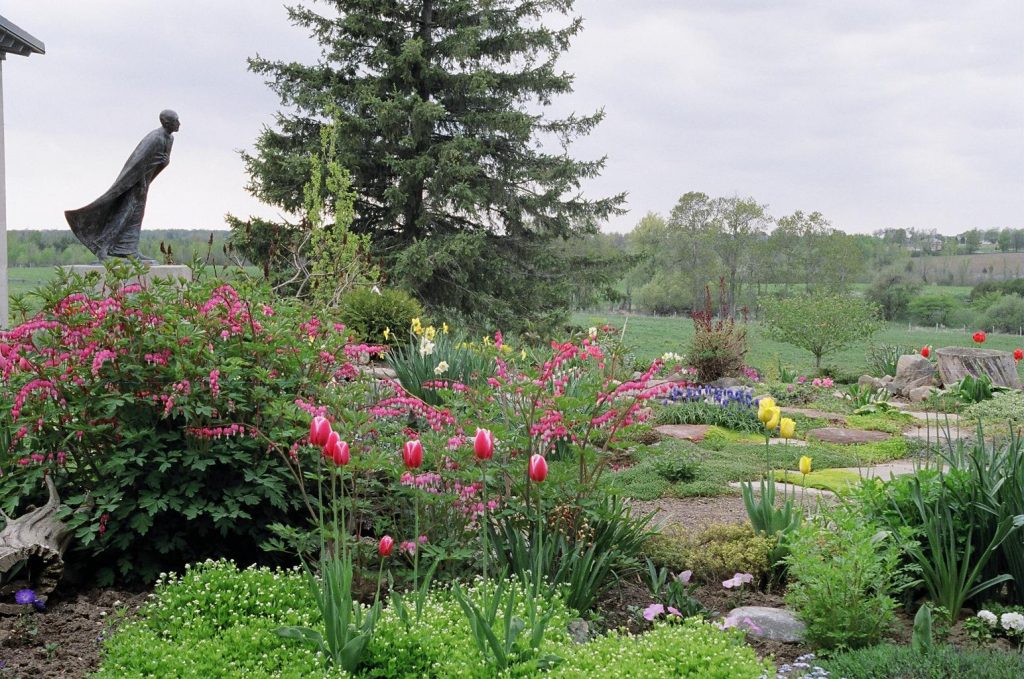
This post is part of the Season of Creation celebration at Ignatius Jesuit Centre!
The Season of Creation is an annual, global ecumenical celebration of prayer and action to protect the environment. From September 1 to October 4, Christians around the world unite to reflect on our relationship with the Creator and all creation, to renew our commitment to care for the Earth, and to take steps toward ecological justice. This year’s theme is Peace with Creation, inviting us to restore harmony with the natural world through justice, reconciliation, and active stewardship. To find out more about Season of Creation, you can visit https://seasonofcreation.org